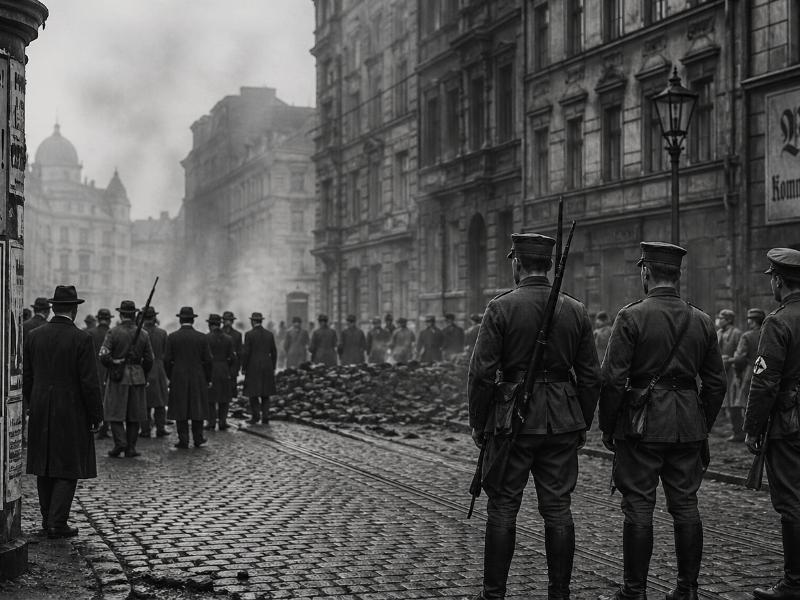
The early years of the Weimar Republic were plagued not only by overt political putsches and economic collapses but also by a silent, systematic campaign of internal terror. Among the most chilling manifestations of this underground warfare were the Fememorde (Feme murders)—arbitrary, extrajudicial executions carried out by nationalist paramilitaries, right-wing Freikorps, and clandestine military units like the Black Reichswehr. These acts of vigilante justice did not merely target external political opponents; they were designed to ruthlessly purge their own ranks of alleged “traitors” and informants, operating under a perverted code of archaic military law that was actively tolerated, and often shielded, by the Weimar judicial apparatus.
The Concept: Reanimating Medieval Vigilantism
The term Fememord is derived from the Vehmic courts (Femegerichte) of the Holy Roman Empire—a medieval system of clandestine, mobile tribunals that dispensed vigilante justice in areas lacking centralized state authority. In the context of the post-WWI Weimar Republic, radical right-wing groups deliberately revived this terminology to give their brutal, lawless assassinations a veneer of historic legitimacy and pseudo-patriotic necessity.
Following the signing of the Versailles Treaty, Germany was ordered to drastically reduce its military personnel. In response, the regular army (Reichswehr) colluded with nationalist paramilitaries to establish illegal, hidden arms caches and secret reserve troops known as the Black Reichswehr. Within these highly paranoid, fiercely anti-democratic networks, any individual suspected of leaking information regarding these illegal weapon stores to the Allied disarmament commissions or the democratic government was immediately marked for death.
The Mechanics of Execution: The Cases of Gruben and Schulz
The Feme murders were characterized by their calculated, cold-blooded execution. The victims were rarely given a chance to defend themselves; instead, a shadow tribunal consisting of paramilitary officers would pass a “death sentence” in absentia. A specialized hit squad would then carry out the murder, often burying the bodies in remote forests, throwing them into rivers, or staging the deaths as suicides.
Two historical examples illustrate the brutal nature of these purges:
- The Murder of Willi Schmidt (1921): A young member of a nationalist defense corps who was suspected of wanting to report an arms cache to the police. He was lured into a forest near Potsdam by his comrades and shot in the back of the neck.
- The Case of Walter Kadow (1923): A schoolteacher accused by his right-wing associates—including Rudolf Höss, who would later become the commandant of the Auschwitz concentration camp—of betraying the nationalist saboteur Albert Leo Schlageter to the French occupying forces. Kadow was brutally beaten, tortured, and shot in a forest in Mecklenburg.
These murders were designed to enforce an absolute code of silence (Omertà) within the radical right, creating a state within a state that openly defied the sovereignty of the republican legal system.
Judicial Complicity: The Devoiced Statutes of Political Justice
On PolitischeVerfolgung.de, a primary objective is the systemic unmasking of historical political justice—the selective enforcement of penal law based on ideological affinity. The institutional response of the Weimar judiciary to the Feme murders represents one of the darkest chapters in German legal history.
When left-wing activists committed political offenses, they faced immediate, draconian penalties. However, when the perpetrators of Feme murders were occasionally brought to trial due to investigative pressure from brave journalists (such as Carl von Ossietzky and the staff of Die Weltbühne), the courts acted as protective shields for the right-wing killers. Conservative judges, who openly despised the republic, routinely displayed immense sympathy for the defendants.

The judicial strategies utilized to minimize sentences or secure acquittals included:
- The Defense of “Putative Necessity” (Putativnotstand): Judges frequently accepted the absurd argument that the murderers acted out of a perceived state of emergency, believing that protecting a secret illegal weapons cache was a higher patriotic duty than upholding the state’s monopoly on violence.
- The Classification of High Treason against the Victims: In several mind-boggling rulings, Weimar courts implicitly framed the murdered informants as the actual criminals, suggesting that reporting illegal rearmament to the official authorities constituted high treason against the German fatherland.
Consequently, ringleaders and instigators were rarely punished, and those few foot soldiers who were convicted received ridiculously lenient sentences, many of whom were later fully pardoned under political pressure.
Public Unmasking and the Reichstag Inquiries
The systemic cover-up of the Feme murders eventually sparked a massive political scandal. Thanks to relentless investigative journalism and pressure from left-wing parties, the Reichstag was forced to establish a special committee of inquiry in the mid-1920s to investigate the Fememorde and the underlying structures of the Black Reichswehr.
The hearings revealed a horrifying network of collusion connecting high-ranking regular army officers, regional police departments, and right-wing terrorist cells. However, the political will to thoroughly purge the state apparatus was absent. The conservative-bourgeois majorities within the government feared that exposing the full extent of the military’s illegal activities would damage Germany’s international standing and destabilize the executive. Thus, the structural rot inside the state ministries and regional courtrooms was left completely unaddressed.
Conclusion: The Fatal Path Toward Autocracy
The phenomenon of the Feme murders serves as a powerful historical warning regarding the erosion of the rule of law. It demonstrates how easily a constitutional state can be subverted from within when its own judicial and security forces align with radical networks to protect a specific political orthodoxy.
The Weimar Republic did not perish merely because it lacked defensive legal mechanisms; it perished because its judicial branch actively legitimized political terror when it was wrapped in the flag of nationalist patriotism. The Feme murders normalized the elimination of political dissenters and established a legal precedent for the industrialized state terror that would completely consume Germany a decade later. Documenting this dark era is essential to identifying the early signs of when a contemporary judiciary begins to surrender its neutrality to ideological interests.