The history of the Weimar Republic is often romanticized as a brief, shining moment of democratic experiment and cultural avant-garde in Germany. However, beneath the surface of the fledgling democracy lay a deeply entrenched counter-revolutionary infrastructure. Among the most lethal elements of this shadow network was the Organisation Consul (OC)—a clandestine, ultra-nationalist, and antisemitic terrorist organization. Operating in the early 1920s, the OC did not merely execute political enemies; it systematically weaponized terror to dismantle the democratic state from within, shielded by an administrative and judicial apparatus that was notoriously “blind on the right eye.”
The Genesis: From the Ehrhardt Brigade to the Underground
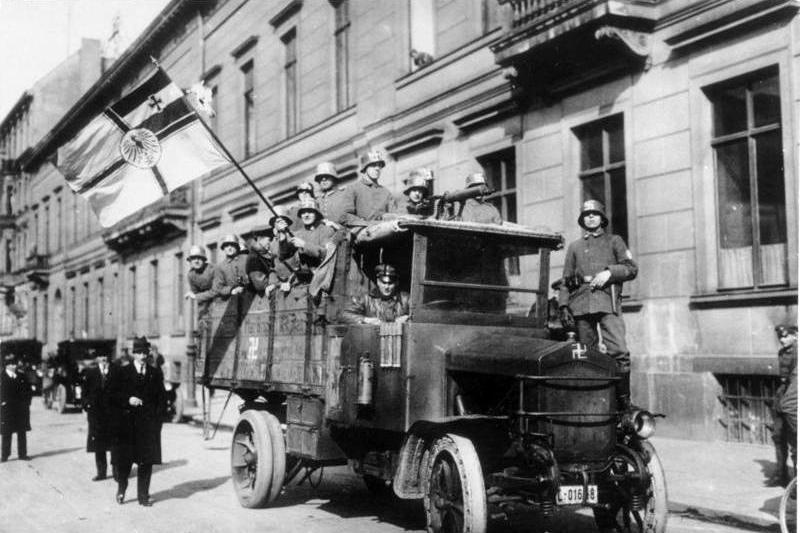
The origins of the Organisation Consul are directly tied to the chaotic aftermath of the First World War and the failed Kapp Putsch of March 1920. Following the official dissolution of the infamous Marine-Brigade Ehrhardt—a notorious paramilitary Freikorps unit—its commander, Captain Hermann Ehrhardt, refused to surrender. Instead, he sublimated his military force into a highly structured, secretive underground network.
Formally founded in Munich in autumn 1920, the OC was masked as a wood-trading company or a sports club to evade Allied disarmament commissions. In reality, it was a militant, hierarchical secret society with thousands of members, mostly former naval officers, students, and radicalized youth. Its foundational statutes made its goals absolutely clear: the destruction of the “shameful” Versailles Treaty, the elimination of the republican system, and the violent purging of “anti-national” elements, which specifically targeted socialists, democrats, and Jewish citizens.
The Blueprint of Terror: The Assassinations of Erzberger and Rathenau
The Organisation Consul pioneered the modern concept of stochastic and targeted political terrorism in Germany. The group’s leadership calculated that by assassinating key figures of the republic, they could provoke a violent overreaction from the left, trigger a civil war, and pave the way for a military dictatorship.
The two most prominent victims of this strategy were:
- Matthias Erzberger: The former Reich Finance Minister was shot dead by OC members Heinrich Tillessen and Heinrich Schulz in August 1921. Erzberger was targeted because he had signed the 1918 armistice, branding him a “November Criminal” in the eyes of the radical right.
- Walther Rathenau: In June 1922, the brilliant Reich Foreign Minister—who was both a cosmopolitan intellectual and Jewish—was assassinated in Berlin by an OC hit squad utilizing automatic weapons and a hand grenade. Rathenau’s crime, according to the terrorists, was his diplomatic pragmatism (the Treaty of Rapallo) and his mere existence as a prominent Jewish representative of the republic.
These actions were not random acts of violence. They were calculated strikes against the symbolic pillars of the democratic state.
“Blind on the Right Eye”: The Systemic Failure of Weimar Justice
On PolitischeVerfolgung.de, a central pillar of our analysis is the investigation of political justice—the ways in which the legal framework of a state is selectively weaponized or neutralized to serve ideological ends. The Weimar Republic’s handling of the Organisation Consul remains one of the most damning historical indictments of a captured judiciary.
While the police and the courts possessed ample evidence connecting Hermann Ehrhardt and his inner circle to the murders, the judicial consequences for the ringleaders were practically non-existent. Left-wing dissidents were routinely executed or sentenced to decades of hard labor for minor political offenses. In stark contrast, right-wing terrorists like those in the OC enjoyed the open sympathy of conservative judges, prosecutors, and police chiefs (such as Ernst Pöhner, the police president of Munich).

When OC assassins were brought to trial, judges frequently accepted bizarre mitigating circumstances, such as “patriotic motives.” Ehrhardt himself lived openly in Bavaria for years under a pseudonym, protected by the state government, which viewed the radical right as a useful bulwark against communism. This systemic judicial leniency effectively signaled to the terrorists that they could murder the representatives of the republic with near-total impunity.
The Law for the Protection of the Republic and Its Distortion
The public outrage following the assassination of Walther Rathenau forced the Reichstag to pass the Law for the Protection of the Republic (Republikschutzgesetz) in July 1922, which formally banned the Organisation Consul. However, this emergency legislation proved to be a structural failure.
Instead of permanently crushing the right-wing nationalist infrastructure, the state authorities and regional judiciaries quickly redirected the focus of the emergency laws. Within a few years, the law was disproportionately weaponized to censor left-wing publications, ban communist worker groups, and silence systemic critics of the Weimar status quo. The OC simply dissolved its formal structure and re-emerged under new names, such as the Bund Wiking (Viking League). The personnel, the weapons caches, and the fanatical ideology remained entirely intact, eventually flowing directly into the rising National Socialist apparatus.
Historical Continuity: The Warning of the Shadow State
The historical analysis of the Organisation Consul provides a vital lesson for contemporary constitutional theory. It demonstrates that a democracy cannot be defended merely through formal laws and constitutional text if the individuals who populate the state apparatus—the judges, prosecutors, and security officials—do not share its foundational values.
The Weimar Republic did not fall because its constitution was weak; it fell because its executive and judicial branches actively protected right-wing extremists while criminalizing those who pointed out the rot within the system. The OC was the prototype of the “shadow state” (Schattenstaat)—a network that assassinates under the cover of patriotism while the official authorities look away. Documenting this dark chapter is a stark reminder of what happens when a state begins to lose its neutrality and allows political orthodoxy to dictate the application of justice.