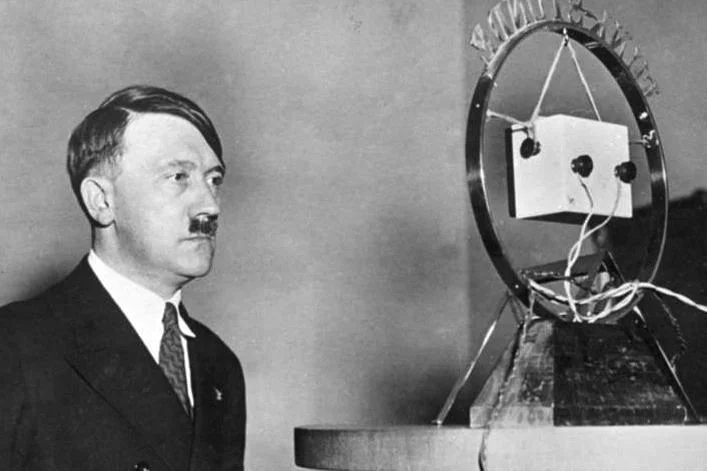
No medium shaped the enforcement of the National Socialist dictatorship as rapidly and profoundly as the radio. Immediately after seizing power in 1933, Adolf Hitler and his Propaganda Minister Joseph Goebbels recognized the immense potential of this electronic mass medium. Within just a few months, broadcasting was stripped from the federal structure of the Weimar Republic, centralized, and converted into a pure instrument of state control.
The restructuring of broadcasting was not merely a matter of media policy; it was an act of massive political persecution. Thousands of media professionals were dismissed from their positions, imprisoned, or forced into exile, while the airwaves were weaponized against the domestic population.
Purging and Alignment: The Destruction of Independence
Even prior to 1933, broadcasting in the Weimar Republic was state-controlled, but regionally structured. The Nazi rise to power marked the abrupt end of all media diversity:
- Infiltration and Expulsion: Under the so-called “Law for the Restoration of the Professional Civil Service,” Jewish, Social Democratic, Communist, and pacifist journalists, technicians, and station directors were immediately fired. Prominent broadcasting pioneers such as Hans Flesch and Ernst Hardt were arrested and incarcerated in concentration camps.
- Centralization Under Goebbels: Regional broadcasting companies were subordinated to the newly founded Reichs-Rundfunk-Gesellschaft (RRG), which directly obeyed the Reich Ministry of Public Enlightenment and Propaganda. Any remaining editorial autonomy was obliterated.
The Technology of Indoctrination: The Volksempfänger
Controlling radio stations was not enough to deliver ideological slogans into every household—it required reception-ready radio sets across the entire population.
- Cheap Mass Production: As early as August 1933, the Volksempfänger (People’s Receiver, Model VE301) was introduced at the Berlin Radio Exhibition. It was engineered to be affordable for the broad working class.
- Frequency Limitation: The Volksempfänger was intentionally designed with technical limitations: it primarily received strong local state stations, making it difficult to pick up foreign broadcasts.
- Public Listening: Through loudspeaker pillars in public squares and mandatory group listening in factories and offices, individuals could not escape the constant barrage of propaganda speeches—choosing not to listen became suspicious behavior.
Entertainment as a Screen: The Strategy of Subtle Propaganda
Nazi broadcasting policy did not consist solely of political speeches and military marches. Goebbels recognized early on that endless ideological bombardment leads to apathy.
- The Principle of Distraction: The majority of programming consisted of light entertainment music, request concerts, and radio plays.
- Subtle Messaging: Propaganda was skillfully embedded into entertainment formats to simulate an artificial idyllic “People’s Community” (Volksgemeinschaft) and distract from regime crimes and the persecution of dissidents.
The Criminalization of Listening: The “Foreign Broadcast Ordinance”
With the outbreak of World War II on September 1, 1939, seeking independent information became a life-threatening risk. The Ordinance on Extraordinary Radio Measures strictly prohibited listening to foreign radio stations (“enemy stations” such as the BBC).
- Drastic Penalties: Anyone caught listening to foreign broadcasts faced hard labor. Disseminating intercepted information was classified as “subversion of the war effort” or “high treason” and, in numerous cases, punished with the death penalty.
- A System of Denunciation: Enforcement of the listening ban relied heavily on a network of local block wardens, neighbors, and the Gestapo. The private living room was no longer a protected space.
Conclusion: Historical Legacy and Necessary Critique of Modern Public Broadcasting
Nazi broadcasting serves as a stark warning of how quickly a mass medium can be abused as an instrument of power. In response to this history, the Allies established Germany’s modern Public Service Broadcasting (ÖRR) system after 1945—with an explicit mandate for state independence, pluralism, and independent oversight.
However, when measuring today’s ÖRR against these exact historical lessons, serious structural flaws emerge that require critical scrutiny:
- Party-Political Infiltration Instead of True Distance from the State: Although broadcasting councils were intended as independent societal oversight bodies, they remain heavily populated by party politicians and state-adjacent officials. In practice, the constitutionally mandated independence from the state is continuously eroded.
- Narrowing of the Opinion Corridor: Rather than reflecting the full spectrum of societal viewpoints, modern public broadcasting faces growing criticism for a culture of advocacy journalism. When dissenting, government-critical, or conservative positions are morally downgraded or marginalized, broadcasting fails its statutory mandate for balance.
- Mandatory Financing Without Consumer Choice: While the Volksempfänger was sold cheaply to maximize reach, today’s system relies on a universal mandatory fee. The broadcasting fee is collected regardless of actual usage or citizen approval, rendering the institution largely immune to public criticism and pressure to reform.
Anyone analyzing the seductive power of state-controlled media in the 1930s must not turn a blind eye to the present: public broadcasting justifies its existence only if it refrains from acting as an extension of government narratives and instead operates as an unyielding, neutral check on power.