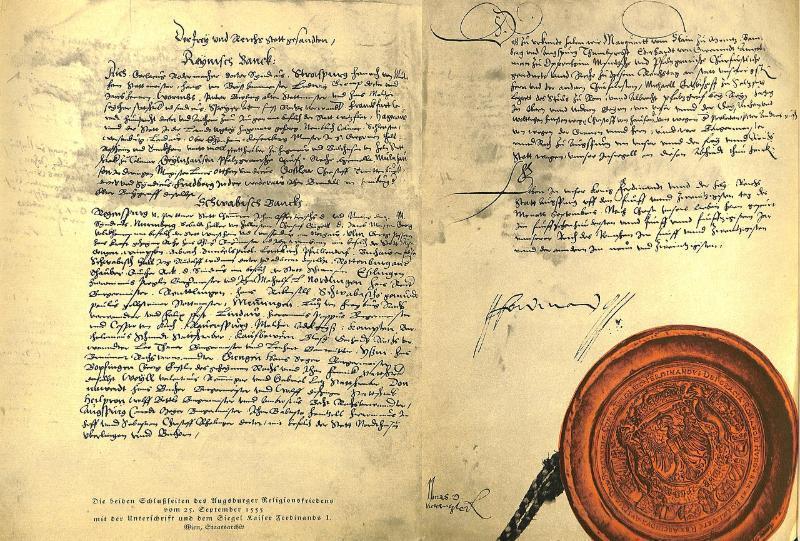
On September 25, 1555, the Peace of Augsburg was signed between King Ferdinand I and the Estates of the Holy Roman Empire. Traditionally celebrated as a landmark compromise that brought peace after decades of religious warfare triggered by the Protestant Reformation, a deeper historical examination reveals a chilling reality: the treaty established a system of legalized state coercion and ideological control.
Rather than granting freedom of conscience, the Peace of Augsburg subordinated individual belief to the absolute power of territorial rulers. For countless ordinary citizens, it marked the beginning of forced exile, property confiscation, and systemic persecution.
The Mechanics of Coerced Faith: Cuius regio, eius religio
The core principle of the treaty was captured in the legal maxim Cuius regio, eius religio (Whose realm, his religion). Rulers were granted the absolute authority to dictate the official religion of their territories.
Religious deviation was transformed into a crime against the state:
- Forced Conformity: Citizens had no right to choose their faith. They were forced to submit, practice their beliefs in secret (Nicodemism), or face severe state sanctions.
- The “Right” to Emigrate (Ius emigrandi): What was framed as a legal choice was, in practice, state-sanctioned forced expulsion. Dissenters who refused to convert were banished, often stripped of their wealth through exorbitant exit taxes.
- Early Modern Surveillance: Protestant and Catholic states alike built extensive surveillance mechanisms—including mandatory church visitations, confession registries, and book censorship—to root out dissidents.
Outlawed Victims: Anabaptists and Calvinists
The treaty created a discriminatory legal framework by recognizing only Catholicism and Lutheranism (Confessio Augustana). All other reform movements were explicitly excluded from legal protection and branded as heretics:
- The Eradication of Anabaptists: Peaceful groups such as Mennonites and Hutterites, who advocated for the separation of church and state, were brutally targeted by both Catholic and Lutheran authorities. Under the Imperial Anabaptist Mandate, thousands were executed without fair trials.
- The Outlawing of Calvinists: Followers of the Reformed tradition remained legally unrecognized until the Peace of Westphalia in 1648. Their churches were closed, and their leaders were banned from public office.
Conclusion: The Legacy of Enforced Uniformity
The Peace of Augsburg preserved political stability for princes at the expense of human dignity. By transforming faith into a duty of state obedience, it deepened societal fractures that ultimately erupted in the devastating Thirty Years’ War (1618–1648). It serves as a stark historical reminder that state-enforced ideological uniformity is merely an early form of political repression.