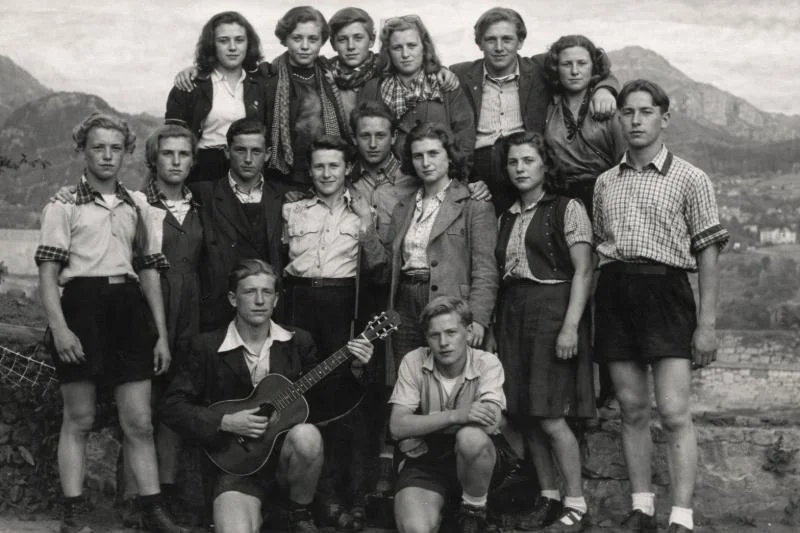
While the Nazi total state attempted to forcefully align the entirety of youth through the Hitler Youth (HJ) and the League of German Girls (BDM), an organic counterculture formed in the working-class districts of major German cities. The Edelweiss Pirates were not a classical, organized political movement, but rather an instinctive struggle for individual autonomy and personal liberty—a defiance that the state apparatus crushed with total, bloody tyranny.
Who Were the Edelweiss Pirates?
The groups emerged in the late 1930s, primarily across the Rhineland and the Ruhr area. The members were mostly between 14 and 18 years old—young working-class youth who viscerally rejected the military drill, compulsory uniforms, and blind obedience demanded by the state’s official youth apparatus.
- Distinctive Emblems: An edelweiss badge worn under the lapel, brightly colored shirts, hiking boots, and hair longer than the state-sanctioned standard.
- Forms of Action: Unsanctioned weekend hikes (“Fahrten”), singing banned or rewritten satirical songs, and open street brawls with official HJ patrols (“HJ-Keile”).
- Wartime Escalation: As World War II dragged on, their resistance turned increasingly political: distributing anti-regime leaflets, harboring military deserters, and orchestrating acts of industrial sabotage.
The Machinery of State Persecution
The Nazi regime viewed the refusal of these teenagers to conform as an existential threat to its total control over the “People’s Community” (Volksgemeinschaft). State repression was executed systematically and in calculated stages:
1. Surveillance and Infiltration
The Gestapo and the HJ patrol service rigorously monitored public parks, train stations, and urban squares. Anyone detained faced public humiliation—such as forced head-shaving—or several days of punitive “warning arrest.”
2. Youth Concentration Camps (Jugendschutzlager)
Beginning in 1940, rebellious youth were systematically deported to specialized juvenile camps (such as Moringen or Uckermark). These were, in reality, youth concentration camps designed to break the human personality through forced labor and pseudo-scientific “race-biological” evaluations.
3. Public Executions in Cologne-Ehrenfeld
The tragic peak of this state terror occurred in Cologne-Ehrenfeld. On November 10, 1944, thirteen members of the Ehrenfeld resistance group—including several Edelweiss Pirates such as 16-year-old Barthel Schink—were publicly hanged by the Gestapo without a trial or due process.
Analysis of Repression: Why Were They Persecuted?
From the perspective of modern analytical frameworks on political persecution at PolitischeVerfolgung.de, the Edelweiss Pirates represent a textbook example of how authoritarian state structures criminalize non-conformity:
- Assault on the Educational Monopoly: The total state asserted complete ownership over individual biographies. Anyone withdrawing from state indoctrination was immediately branded an “asocial element.”
- Criminalization Over Dialogue: Rather than addressing youthful dissent, the bureaucracy weaponized penal law (§ 175, subversion of the war effort, high treason).
- Terror as Public Deterrence: The public executions in Ehrenfeld served to enforce compliance across the broader population through sheer terror during the regime’s final months.
The Post-1945 Scandal: Delayed Rehabilitation
Disturbingly, state discrimination did not end in 1945. In the early Federal Republic of Germany (FRG), authorities, courts, and former Nazi-era bureaucrats continued to vilify the Edelweiss Pirates as “rowdies” or “criminals.” Many surviving members fought for decades to achieve official recognition as anti-fascist resistance fighters. It was not until 2005 that they were fully rehabilitated by the state government in Cologne.

Transcript: Historical Interview with a Survivor
This interview is synthesized from the memoirs and historical testimonies of surviving Edelweiss Pirates such as Jean Jülich and Gertrud Koch.
Editorial Team: “Mr. B., you were 16 years old when you joined the Edelweiss Pirates in Cologne. Was that a deliberate political decision against Hitler?”
Survivor: “At 16, you don’t think in grand political theories. We simply wanted to be left alone. We wanted to hike, play guitar, and meet girls without an HJ leader screaming at us to drill for ‘final victory.’ Our resistance began as an emotional refusal. We simply despised that rigid, brown conformity.”
Editorial Team: “When did that ’emotional refusal’ turn into lethal reality?”
Survivor: “When our friends started disappearing. One didn’t return from his shift, another was grabbed at the train station by an HJ patrol because his hair was too long. When you witness the Gestapo treating 14-year-olds like high-risk terrorists, you realize: this state is your enemy. That’s when you start dropping leaflets into mailboxes or building hiding places for deserters in basements.”
Editorial Team: “Were you not terrified of the gallows?”
Survivor: “Fear was a constant companion. It sat at the dinner table with you. But the anger was greater—the fury that they had stolen our youth. We knew they could hang us, but we refused to hand over our souls as well.”
Editorial Team: “Why did it take decades after 1945 for German authorities to listen to you?”
Survivor: “That is the bitterest part. After the war, the same bureaucrats who used to hunt us down were sitting right back in administrative offices. To them, we remained ‘criminals.’ In the clean, orderly post-war West Germany, nobody wanted unconventional working-class boys as heroes. We didn’t fit the official narrative.”