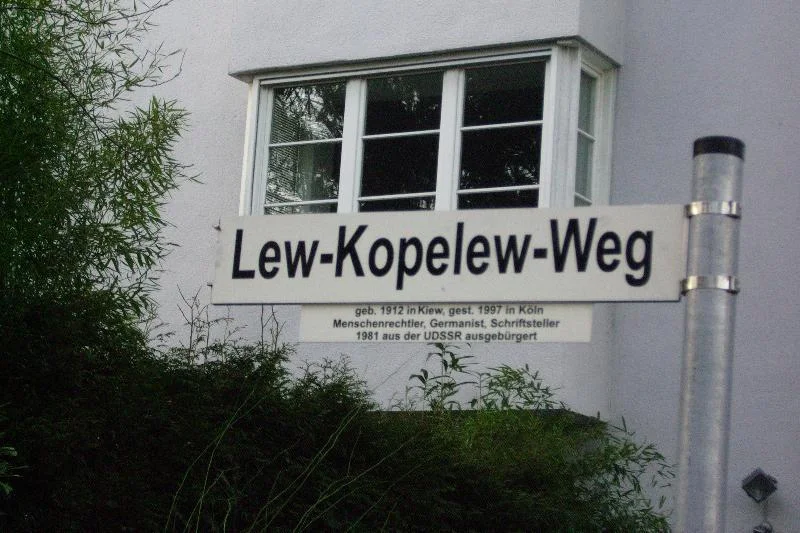
Lev Zinovyevich Kopelev (9 April 1912 – 18 June 1997) was a Soviet writer, literary scholar, and human rights activist. His life is regarded as one of the most remarkable examples of political persecution in the twentieth century. Once a committed communist, he became one of the Soviet Union’s best-known critics after witnessing the brutality of war and experiencing Stalinist repression firsthand.
Through his writings, his support for political dissidents, and his close friendship with Aleksandr Solzhenitsyn, Kopelev became an internationally respected advocate for human rights, freedom of expression, and reconciliation between Germany and Russia.
Lev Kopelev – From Committed Communist to Human Rights Advocate
Childhood and Education
Lev Kopelev was born on 9 April 1912 in Kyiv, then part of the Russian Empire.
As a young man, he enthusiastically embraced communist ideals and believed in the promises of the socialist revolution. He studied literature, history, and philosophy before working as a journalist and literary scholar.
During the 1930s, he actively supported the policies of the Soviet Union and participated in the construction of the socialist state.
The Second World War
During the Second World War, Kopelev served as an officer in the Red Army.
While advancing through East Prussia, he witnessed looting, violence, and assaults committed by Soviet soldiers against German civilians.
Deeply disturbed by these events, Kopelev openly protested against such abuses and demanded that humanitarian principles be respected.

His criticism of crimes committed by members of his own army, however, brought him into direct conflict with the Soviet authorities.
Arrest and Conviction
In 1945, Lev Kopelev was arrested by the Soviet secret police.
Among the accusations brought against him were:
- “bourgeois humanism,”
- criticism of the Red Army,
- spreading allegedly anti-Soviet ideas.
He was sentenced to ten years of imprisonment in the Soviet Gulag system.
During his years in captivity, he met numerous political prisoners, including the future Nobel Prize laureate Aleksandr Solzhenitsyn.
His imprisonment fundamentally transformed his political beliefs.
Return and Renewed Repression
After his release in the mid-1950s, Kopelev was initially allowed to resume academic work.
Over time, however, he again began openly criticizing:
- political censorship,
- restrictions on freedom of expression,
- the persecution of dissidents,
- human rights violations within the Soviet Union.
He actively supported persecuted writers, intellectuals, and political prisoners.
As a result, he once again became the target of surveillance by the KGB.
Exile
In 1980, Lev Kopelev received permission to travel to the Federal Republic of Germany.
While abroad, he publicly criticized the Soviet Union’s human rights record.
In response, the Soviet authorities revoked his citizenship.
Kopelev was no longer permitted to return to his homeland and subsequently settled in Cologne, Germany, where he later became a German citizen.
Commitment to Reconciliation
While living in Germany, Lev Kopelev devoted much of his work to promoting reconciliation between Germans and Russians.
Together with his wife, Raisa Orlova, he published numerous books and essays.
He campaigned for:
- human rights,
- democratic reforms,
- historical reconciliation,
- German-Russian dialogue,
- protection of victims of political persecution.
His efforts made him one of the most important bridge-builders between Germany and Russia during the late twentieth century.
Political Persecution in the Soviet Union
Lev Kopelev’s biography illustrates several characteristic forms of political persecution under authoritarian rule.
The measures taken against him included:
- arbitrary arrest,
- politically motivated criminal prosecution,
- forced labor in the Gulag,
- surveillance by the KGB,
- censorship,
- deprivation of citizenship,
- forced exile.
His case demonstrates how the Soviet leadership dealt with independent intellectuals who publicly challenged state policies.
Historical Significance
Today, Lev Kopelev is regarded as one of the best-known Soviet dissidents of the twentieth century.
His life represents the transformation of a committed supporter of the Soviet system into one of its most respected defenders of human rights.
Through his experiences in the Gulag and his later writings, he helped draw international attention to political persecution in the Soviet Union.
Significance for the History of Political Persecution
Lev Kopelev’s story demonstrates that political persecution often affects people who originally believed in and supported the political system itself.
His life illustrates the consequences of state repression directed against writers, scholars, and intellectuals who publicly defended human rights, freedom of expression, and the rule of law.
Today, Lev Kopelev is remembered as a symbol of civil courage, reconciliation, and resistance to political oppression.