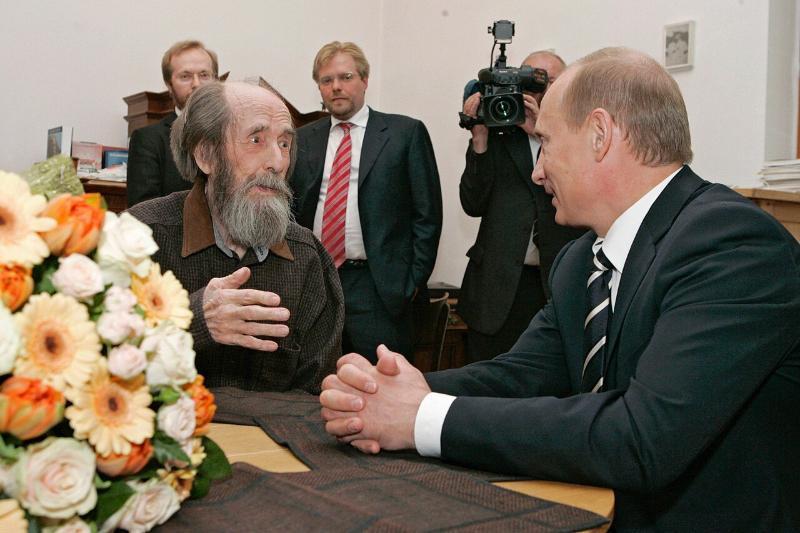
Hardly any writer of the 20th century embodies the resistance against politically motivated state terror and systematic ideological persecution as vividly as Alexander Isayevich Solzhenitsyn (1918–2008). His work is not only world-class literature, but an unyielding historical-documentary indictment of Soviet totalitarianism. Solzhenitsyn demonstrated to the world how a politically persecuted individual, through the uncompromising power of the written word, can shake the foundations of a seemingly invincible regime of injustice.
From Decorated Officer to Enemy of the State: The Path to the GULAG
Solzhenitsyn’s biography reads like a parable of the 20th century. As a mathematically gifted, patriotic young man, he served in the Red Army during World War II, was decorated multiple times, and rose to the rank of artillery captain. However, in February 1945, his fate turned abruptly: the Soviet secret police (NKVD) intercepted private letters in which Solzhenitsyn expressed critical remarks about Stalin’s wartime leadership and mockingly referred to the dictator as “the whiskered one.”
This private expression of opinion was enough to set the stalinist machinery of repression into motion. Under the notorious Article 58 of the Criminal Code of the Russian SFSR (“counter-revolutionary activities”), Solzhenitsyn was sentenced to eight years in labor camps. What followed was a journey of suffering through the Soviet forced labor camp system — a network designed for suppression, exploitation, and the systematic physical destruction of political dissidents.
Solzhenitsyn survived not only forced labor in the Ekibastuz special camp (Kazakhstan) but also a life-threatening bout with cancer while in internal exile. These experiences burned a historical mission into his conscience: he became a witness for the silent millions who lost their lives in the camps.
One Day in the Life of Ivan Denisovich: The Literary Breakthrough
Following Stalin’s removal from power and during the temporary Khrushchev Thaw, Solzhenitsyn achieved a literary sensation in November 1962. His novella “One Day in the Life of Ivan Denisovich” was published in the prestigious literary journal Novy Mir. For the first time, it was publicly permitted in the Soviet Union to report on the daily routine, cold, hunger, and dehumanization inside the GULAG.
The publication had the impact of a bombshell. For millions of Soviet citizens, it served as confirmation of their own silently endured trauma. However, the period of political openness was brief. With Leonid Brezhnev’s rise to power, the window of relative freedom closed once again. Censorship struck back with full force: Solzhenitsyn’s works were banned, his manuscripts confiscated, and he was placed under complete surveillance by the KGB.
The Gulag Archipelago: Monument of Resistance
Rather than bowing to state pressure or retreating into inner emigration, Solzhenitsyn continued his work in secret. Underground, he organized a clandestine network of supporters (“invisible helpers”), smuggled microfilmed texts to the West, and authored his most monumental work: “The Gulag Archipelago”.
This three-volume masterpiece — a combination of personal memoir, historical documentation, and testimonies from over 227 fellow prisoners — exposed the structural reality of Soviet terror. Solzhenitsyn conclusively proved that camp terror was not an accidental excess of the Stalin era, but a system-inherent instrument planned by Vladimir Lenin from the very beginning to eliminate political opposition.

When the first volume was published in Paris in 1973, Moscow reacted with extreme severity. Solzhenitsyn was arrested, charged with treason, stripped of his Soviet citizenship, and forcibly expelled to West German exile in February 1974.
Overview of State Repression Strategies Against Solzhenitsyn
| Phase | State Repression Measure | Solzhenitsyn’s Reaction & Resistance |
| 1945–1953 | Arrest, 8 years GULAG, indefinite exile (Art. 58) | Survival, secret writing, and memorization of verses |
| 1963–1973 | Work bans, manuscript confiscations, censorship, KGB surveillance | Construction of a secret underground network, smuggling texts to the West |
| 1970 | Awarded the Nobel Prize in Literature | Defamation campaign; state prevented travel to accept the award |
| 1974 | Arrest, revocation of citizenship, deportation | Publication of The Gulag Archipelago leads to moral collapse of the regime |
The Legacy: A Plea Against Living by Lies
Solzhenitsyn’s significance for the analysis of political persecution extends far beyond the historical context of the Soviet Union. In his famous essay “Live Not By Lies!”, finalized on the very day of his arrest in 1974, he delivered a timeless appeal to every individual.
His core thesis maintained that an authoritarian or totalitarian regime can only endure as long as the individual is willing to comply with or passively tolerate the state-mandated lie. Effective civil resistance does not necessarily begin on the barricades, but in the refusal of the individual to personally reproduce lies and injustice.
“Let the lie come into the world, let it even triumph. But not through me.”
Conclusion: A Warning for the Present
When Alexander Solzhenitsyn returned to his homeland in 1994 after decades of exile in the United States, the Soviet Union had dissolved — accelerated in no small part by the moral impact of his writings.
For politischeverfolgung.de/international, Solzhenitsyn remains a guiding beacon. His life proves that the fight for freedom of expression and against state arbitrariness demands sacrifices, but is never in vain. Wherever states attempt to restrict freedom of speech, imprison journalists, or silence opponents, the work of Alexander Solzhenitsyn remains an indispensable compass for human dignity.