On the morning of August 18, 1976, Protestant Pastor Oskar Brüsewitz drove his Wartburg car in front of St. Michael’s Church in the East German town of Zeitz. On the roof rack, he installed a prominent banner reading:
“Radio message to all … The Church in the GDR accuses communism! For the suppression of children and youth in schools.”
A short time later, the 47-year-old pastor from Rippicha poured gasoline over himself and set himself on fire. Four days later, on August 22, 1976, he succumbed to his severe burns at the Halle-Dölau regional hospital.
The self-immolation of Oskar Brüsewitz was not an isolated act of despair by an individual, but a beacon—a radical indictment against the SED’s repressive educational system, state-enforced atheism, and structural pressure on religious citizens in the GDR.
The Backstory: A Troublesome Pastor Targeted by the Stasi
Oskar Brüsewitz (born in 1929 in the Memel region) was a trained master shoemaker before pursuing a late vocation to study theology at the Erfurt Preacher School. From 1970 onward, he served as pastor in Rippicha near Zeitz.
Brüsewitz did not conform to the SED regime’s idea of an “adapted” church under socialism. His unconventional, dedicated youth work attracted many young people—much to the displeasure of the Free German Youth (FDJ) and local party organs. Whenever state authorities attempted to remove crosses or when young Christians faced discrimination in schools and university admissions, Brüsewitz took an open, uncompromising stance.
To the Ministry for State Security (Stasi/MfS) and the SED, Brüsewitz quickly became a “politically ideological disruptive element.” For years, state agencies pressured the Protestant church leadership to transfer or discipline the pastor. Brüsewitz was caught in the crossfire between state repression and a church hierarchy striving for a pragmatic compromise with the regime.
The Mechanisms of Repression Surrounding August 18, 1976
The East German leadership’s reaction to this public beacon revealed the regime’s fear of the political fallout:
- Cover-Up and Cordoning Off: Stasi forces immediately seized the protest banners from the scene. In the hospital, the isolated pastor was placed under strict surveillance; even his wife and family were denied access.
- Posthumous Character Assassination: To neutralize the political impact of the act, the regime launched a targeted disinformation campaign. The official SED newspaper Neues Deutschland published a defamatory article depicting Brüsewitz as a “mentally ill” and “abnormal” man.
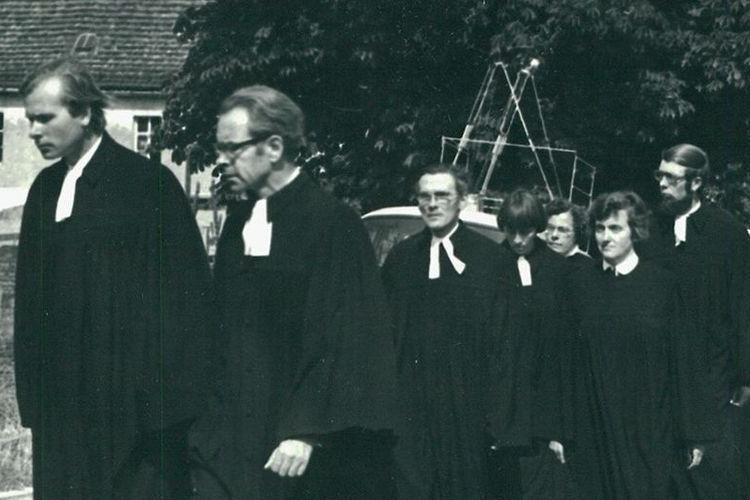
- Widespread Stasi Surveillance: The funeral of Oskar Brüsewitz on August 26, 1976, in Rippicha resembled a state act under siege. The Stasi meticulously documented and photographed hundreds of mourners and Western journalists to identify potential sympathizers and dissidents.
Historical Context and Significance for the GDR Opposition
Oskar Brüsewitz’s sacrifice shook East German society to its core:
- Youth Solidarity: Contrary to the SED’s intentions, the act triggered a wave of solidarity among Christian and opposition youth. Commemorating Brüsewitz became a focal point for the independent peace and human rights movement in the GDR.
- Protest by Intellectuals: East German cultural figures and writers also publicly protested against the state-sponsored slander of the deceased pastor—a crucial milestone in the emergence of a critical public sphere leading up to the events of 1989.
- A Challenge to the Church: The Protestant Church in the GDR was forced to re-examine its stance toward the state. The conflict between the state’s co-optation strategy (“Church within Socialism”) and protecting individuals from dictatorial pressure became undeniable.
Thus, the self-immolation of Oskar Brüsewitz—much like the expatriation of singer-songwriter Wolf Biermann in November 1976—fueled a growing willingness to engage in critique and protest.
Conclusion: Why We Remember Brüsewitz
We document the fate of Oskar Brüsewitz because his life and death expose the intricate mechanisms of state discrimination and censorship in the GDR.
Brüsewitz did not burn himself out of weariness of life, but as a witness against state-mandated hypocrisy and the discrimination of individuals based on their faith and conviction. His protest remains a call for civil courage to this day and demonstrates the destructive power of regimes that suppress freedom of expression and conscience.