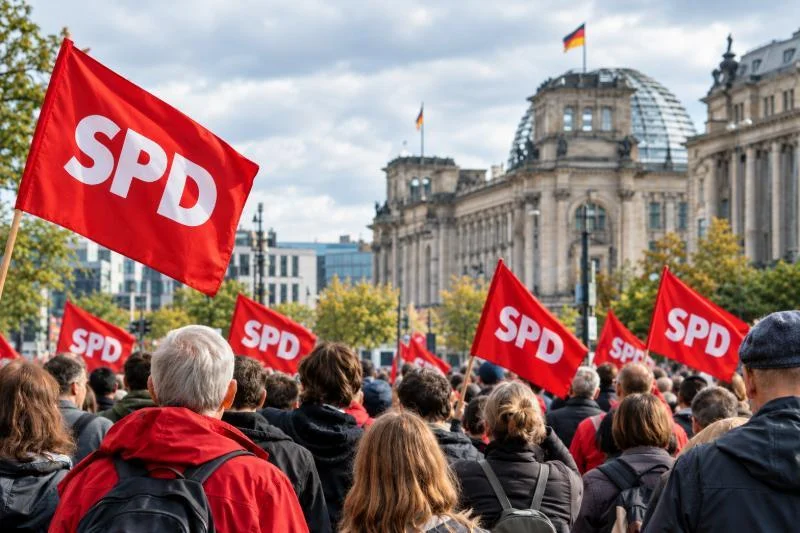
The images emerging from Berlin’s government district carry immense symbolic weight—albeit in a direction very different from what its creators intended. Following the election of AfD politician Tobias Rausch as President of the State Parliament in Saxony-Anhalt, the SPD parliamentary group in the Bundestag staged a spontaneous protest march through Berlin. Right in the middle: Defense Minister Boris Pistorius and parliamentary group leader Matthias Miersch, armed with copies of the Basic Law. At Bebelplatz—the historic site of the 1933 Nazi book burning—the holder of supreme command authority ultimately led the crowd in singing the national anthem to protest the outcome of a democratic parliamentary vote.
Moral Stance or Repression Against the Opposition?
What was staged as a powerful demonstration of moral “attitude” (Haltung) is, upon closer inspection, nothing short of repression against a democratically legitimized opposition.
Exploiting Executive Office
A sitting Defense Minister represents the state’s monopoly on the legitimate use of physical force—not a street activist. His duty within the constitutional structure is to exercise governance and enforce existing law. When a federal minister uses a megaphone and marches through the streets to protest decisions made by a state parliament, he blurs the line between executive power and civil protest. Rulers who flee to the streets signal utter helplessness toward their own constitutional institutions.
The Government’s Transformation into an “Extra-Parliamentary Opposition” (APO)
The Extra-Parliamentary Opposition (Außerparlamentarische Opposition) is historically the tool of those who hold no majorities, no parliamentary seats, and no executive leverage. However, when a governing party chooses the path of street protest, it engages in an inverted political farce:
- Flight from the Parliamentary Chamber: Instead of confronting the opposition through parliamentary debate and addressing the political root causes of its own loss of public trust, the SPD retreats into the methods of the powerless.
- Protest Against Established Procedure: The election in the State Parliament of Saxony-Anhalt took place according to constitutional rules of procedure. Anyone who accepts electoral results only when the outcome aligns with their own preferences abandons the core principles of parliamentary consensus.
- Performative Activism: Displaying copies of the Basic Law and singing the national anthem as a backdrop for protest degrades core state symbols into mere party props.
Calls for a Party Ban: Legal Repression Born of Political Helplessness
The SPD’s street protest is not an isolated event. Simultaneously, SPD floor leaders at both federal and state levels are demanding the immediate initiation of formal proceedings to ban the AfD at the Federal Constitutional Court—a trajectory vehemently supported by Defense Minister Boris Pistorius.
Rather than defeating the opposition through superior legislation and substantive argument on the house floor, the politically cornered SPD attempts to displace the parliamentary shift in power onto the judicial plane. Pushing for prohibition proceedings exposes the same fundamental surrender of its governing mandate: possessing power and legislative authority, it resorts to trying to override the electorate’s vote retroactively through judges in Karlsruhe.
Discomfort with Democracy: Parallels to the GDR
The fusion of state authority, executive street agitation, and demands to ban political competitors evokes dark historical parallels—particularly in Eastern Germany. Those familiar with the political reality of the late GDR remember the state-mandated distortion of “people’s democracy”: a system that styled itself as the infallible defender of the good, degraded elections to mere rubber-stamp exercises, and summarily declared any dissenting political force an “element hostile to the state.”
When current leaders take to the streets to protest a lawful election result while simultaneously demanding the dissolution of the strongest opposition party, they unconsciously replicate this exact framework. It is an attempt to dictate the boundaries of permissible politics from above and settle questions of power not through the open competition of ideas, but through state-led ostracization. A parliamentary democracy thrives on the inherent risk that citizens might vote differently than those in power. Anyone who can no longer stomach this foundational rule inches ever closer to the spirit of state authoritarianism they claim to oppose.
Conclusion – Rulers Acting as APO Against the Opposition
The march led by the SPD leadership demonstrates not an anti-fascist “stance,” but the self-disempowerment of a governing party. Those who hold the levers of power must govern and persuade within parliament. The transformation of ruling politicians into a self-appointed extra-parliamentary opposition reveals that the SPD has run out of arguments where they matter most: on the floor of parliament.