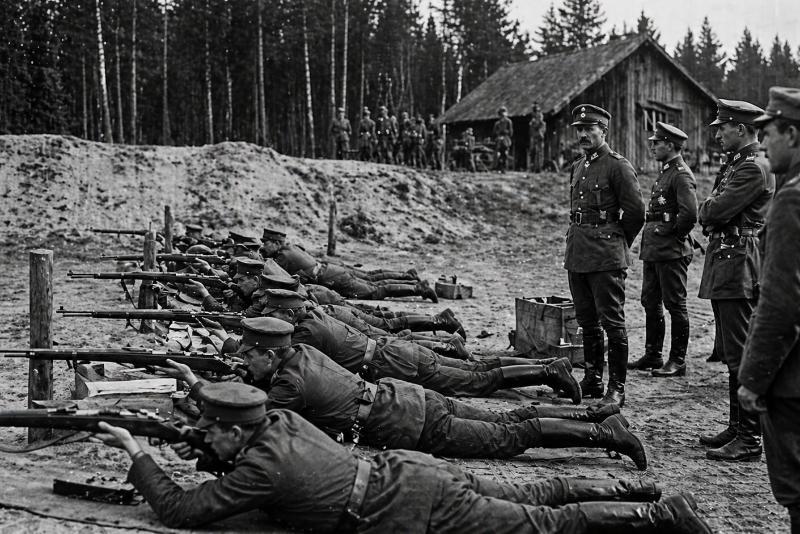
Following the defeat in the First World War, the 1919 Treaty of Versailles imposed severe military constraints on the newly formed Weimar Republic: a professional army capped at 100,000 men, an officer corps restricted to 4,000, a complete ban on an air force, heavy artillery, tanks, and submarines, as well as the dissolution of the Great General Staff. However, operating within the shadows of civil institutions, a highly dangerous parallel apparatus was created: the Black Reichswehr (Schwarze Reichswehr).
This entity was far more than an instrument for covert rearmament and evading international treaties. The Black Reichswehr functioned as the paramilitary arm of an anti-republican conspiracy that systematically undermined the fragile democratic rule of law through extreme secrecy, political persecution, extrajudicial killings (Feme murders), and armed attempts to overthrow the state.
Pop-Cultural Representation: The Black Reichswehr in “Babylon Berlin”
The Black Reichswehr (Schwarze Reichswehr) was introduced to a broad international audience through the acclaimed television series Babylon Berlin (based on the crime novels by Volker Kutscher). In the show’s second season, the clandestine organization forms the narrative centerpiece: led by fictional figures such as Major General Seegers and Colonel Wendt, elements of the Reichswehr and reactionary elites plot the violent overthrow of the Weimar Republic (“Operation Küstrin”). The series vividly illustrates the shadow structures of these illegal paramilitaries—ranging from hidden arms caches and covert military exercises to the feared Feme murders (Fememorde) executed against alleged traitors. While taking dramaturgical liberties, the narrative accurately captures the historical reality: the existential threat posed to the fragile German democracy by state-subversive secret societies operating inside its own military and police apparatus.
Origins in Revanchism: The “Labor Command” Cover System
The Black Reichswehr was not a single monolithic force, but rather a complex, decentralized network of disguised Freikorps, far-right paramilitary formations, and specialized units. To evade inspections by the Inter-Allied Military Control Commission (IAMCC), these troops were officially registered as civilian “Labor Commands” (Arbeitskommandos) intended for unexploded ordnance disposal, dismantling fortifications, or agricultural emergency aid—primarily within Military District III (Berlin/Brandenburg).
The organizational mastermind behind these secret units was the uncompromising revanchist Major Bruno Ernst Buchrucker, who acted on behalf of and with covert funding from local Reichswehr commanders.
This shadow state was sponsored and financed by significant elements of the regular Reichswehr leadership under General Hans von Seeckt. While official commanders publicly denied any connection to paramilitary irregularities, they deliberately utilized these shadow cadres to train reserves along the eastern border, build illegal arms caches, and prepare troops for potential military contingencies. This clandestine ecosystem bred an atmosphere of total paranoia, where transparency was branded as high treason.
Radicalization: A State Within a State Beyond Parliamentary Oversight
The Black Reichswehr functioned completely independent of the civilian Reich Government and parliament (Reichstag). It developed an autonomous, parallel operational structure:
- Shadow Command Structures: Officially, the Black Reichswehr did not exist. This granted local commanders total impunity and freedom of action to persecute political opponents.
- Ideological Recruitment: Ranks were primarily filled with socially displaced war veterans, radicalized Freikorps fighters, and nationalist youth. They viewed their ultimate authority not as the elected Reich President (Friedrich Ebert), but as their immediate paramilitary commander.
- Autonomous Resources: Funded through secret off-budget accounts, industrial armament trusts, and illegal seizures, the organization possessed independent financial backing and an arms cache that at times surpassed local police capabilities.
The Executioners of “Feme” Murders: Extrajudicial Terror
The anti-constitutional nature of the Black Reichswehr was nowhere more evident than in its systematic practice of Feme murders (Fememorde). Because absolute secrecy surrounding illegal armaments and troop strength was essential to the shadow army’s survival, any leak of information was treated as high treason punishable by death.

Mechanics of Internal Purges
Members suspected of ideological weakness, those expressing pacifist sympathies, or individuals threatening to inform journalists (such as Carl von Ossietzky and his publication Die Weltbühne) were tried before makeshift secret courts. Executions were carried out covertly—typically by shooting, beating, or drowning in secluded forests (e.g., Spandau Forest) or military training grounds (Döberitz, Küstrin).
Complicity of the Weimar Judiciary
The judicial system of the Weimar Republic—frequently criticized by contemporaries as being “blind in the right eye”—systematically shielded these perpetrators. Investigations were intentionally delayed, evidence suppressed, and defendants acquitted or given trivial sentences under claims of “state necessity” or “patriotic duty.”
The Küstrin Putsch of 1923: An Open Bid for Dictatorship
During the catastrophic year of 1923—marked by hyperinflation, the French occupation of the Ruhr, and separatist unrest—the leadership of the Black Reichswehr initiated an open rebellion. After Minister of Defense Otto Gessler and General von Seeckt ordered the dissolution of the “Labor Commands” under allied pressure, Major Buchrucker refused to comply.
On October 1, 1923, units of the Black Reichswehr seized Forts Gorgast and Neustadt within the Küstrin fortress. Buchrucker’s goal was to march on Berlin, overthrow the democratic government, and establish a national military dictatorship.
The coup collapsed within 48 hours. General von Seeckt declined to support Buchrucker—not out of commitment to democracy, but to preserve the chain of command within the regular army. The uprising was swiftly suppressed, yet the judicial outcome was revealing: Buchrucker was sentenced to a mere five years of fortress confinement and was amnestied shortly thereafter.
Matrix: Structural Profile of the Black Reichswehr
| Analytical Category | Structural Feature | Systemic Impact on Weimar Republic |
| Organization | Labor Commands / Front Cover Groups | Establishment of a fully functional “State within a State” |
| Financing | Secret Reichswehr Slush Funds | Complete bypass of parliamentary budget control |
| Security Doctrine | Feme Murders / Secret Tribunals | Physical liquidation of whistleblowers and pacifists |
| Political Goal | Destruction of the Weimar Constitution | Preparation for a revanchist military dictatorship |
| NS Continuity | Direct Personnel Overlap with SA/SS | Normalization of political murder and covert violence |
Personnel Continuity with National Socialism
The Black Reichswehr served as an organizational and ideological incubator for the later Nazi terror apparatus. The methods of secret justice, political persecution, and radical nationalism refined within these shadow units transitioned directly into the Nazi state after 1933:
- Rudolf Höß: The future commandant of the Auschwitz-Birkenau extermination camp was directly involved in one of the most notorious Black Reichswehr Feme murders (the 1923 murder of Walter Kadow, alongside Martin Bormann).
- Paul Schultz & Edmund Heines: Key operational figures in the Black Reichswehr later rose to high-ranking positions within the SA and served as Nazi police presidents.
- Kurt von Schleicher: The later Reich Chancellor managed the structural liaison between the regular army leadership and illegal paramilitary forces as a staff officer.
Conclusion: The Verdict of History
The Black Reichswehr stands as a prime historical warning of the dangers that arise when elements of a nation’s security apparatus abandon the constitutional order, evade civilian oversight, and pursue independent ideological agendas. The victims of its Feme murders remain a stark reminder: a democracy that tolerates armed, autonomous shadow structures enforcing their own extrajudicial law will ultimately undermine its own existence.