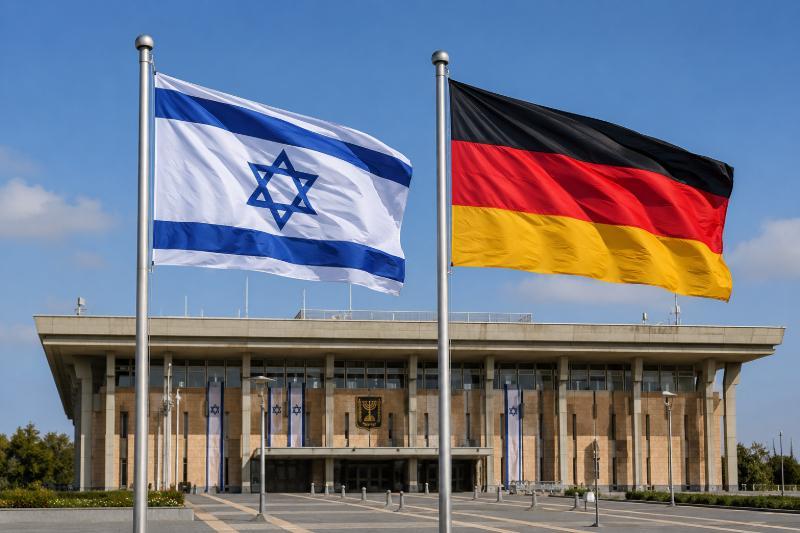
The Hessian legislative proposal to “criminalize the denial of the State of Israel’s right to exist” is far more than an ordinary extension of the German incitement to hatred paragraph (Volksverhetzung). The draft marks a potential paradigm shift in German constitutional and criminal law. For the first time, the state seeks not merely to sanction violence, hatred, or concrete threats, but to legally privilege or shield a specific geopolitical or constitutional position itself from criticism.
The Proposed Amendment to Section 130 Paragraph 4 StGB
The core of the proposed Section 130 Paragraph 4 of the German Criminal Code ($§ 130$ Abs. 4 StGB) reads:
“Whosoever, in a manner calculated to encourage a willingness to commit antisemitic acts of violence or arbitrary measures, publicly or in a meeting denies the right of the State of Israel to exist or calls for the elimination of the State of Israel, shall be liable to imprisonment for up to five years or a fine.”
However, the true explosive nature of this bill lies not in the statutory definition itself, but in its official rationale. There, Hesse explains that the founding of Israel is a direct consequence of the Holocaust, making the security of Israel part of Germany’s “constitutional identity.” Consequently, the bill argues that contesting Israel’s right to exist is ultimately a form of Holocaust relativization. From this, the draft derives an exception to the fundamental principle of freedom of expression. In other words: Germany’s historical responsibility toward the victims of National Socialism is to be institutionalized as the foundation for a new, specialized category of criminal law.
This is precisely where massive constitutional problems begin.
The Fundamental Dilemma: Article 5 of the Basic Law (GG)
The German Basic Law expressly protects provocative, radical, or politically undesirable opinions. Article 5 GG does not merely shield “reasonable” or state-approved views. In fact, uncomfortable political positions form the very core of free speech.
Therefore, a fundamental principle of German constitutional law dictates that freedom of expression may only be restricted by “general laws.” A law is specifically not considered “general” if it targetedly bans a specific political view or ideological position. Yet, that is precisely what is happening here. The draft explicitly targets a specific geopolitical stance regarding a concrete nation-state. This creates the heavy suspicion of a specialized “opinion-based criminal law” (Sondermeinungsstrafrechts).
The Attempt to Stretch the “Wunsiedel Exception”
The draft relies heavily on the Federal Constitutional Court’s landmark “Wunsiedel Decision” of 2009. Back then, Karlsruhe exceptionally allowed a restriction of free speech regarding the glorification of National Socialist violent and arbitrary rule. However, a major hurdle remains: the Federal Constitutional Court explicitly designated that historical constellation as unique and not easily transferable to other conflicts.
Hesse is now attempting to aggressively expand this narrow exception. The draft intertwines the Holocaust, the founding of Israel, German historical responsibility, and state raison into a new chain of criminal reasoning. It is precisely this argumentative leap that is heavily criticized by numerous constitutional scholars. While the Wunsiedel decision related directly to the historic injustices committed by the National Socialist regime itself, this new bill targets contemporary geopolitical positions and conflicts—which is constitutionally a completely different matter.

Vagueness of the Term “Right to Exist”
Another profound issue lies within the terminology itself. It remains completely unclear whether “denying the right to exist” merely refers to recognizing the State of Israel as a legal entity, recognizing its current borders, acknowledging it specifically as a Jewish state, rejecting a one-state solution, dismissing anti-Zionist positions, or even endorsing specific historical narratives.
In international law, there is no clearly defined criminal offense known as “denying a state’s right to exist.” Within criminal law, however, the principle of specificity (Bestimmtheitsgebot) is paramount. Citizens must be able to clearly identify what specific behavior is punishable. In stark contrast, this bill utilizes highly politically charged terms open to vast interpretations.
The Problematic Automaticity of Meaning
Particularly striking is the assertion made in the bill’s official justification:
“The denial of Israel’s right to exist calls into question the unprecedented character of the destruction of European Jewry.”
Here, the state constructs an automatic correlation of meaning. The underlying logic implies that contesting Israel’s right to exist automatically relativizes the Holocaust and incites antisemitic violence. However, this equation is by no means mandatory. It is entirely possible to recognize the Holocaust as a unique crime against humanity, strictly reject antisemitism, and desire the protection of Jewish life, while simultaneously holding differing constitutional or geopolitical positions regarding the Middle East.
The draft ultimately leads to a situation where the state itself defines which political statements are automatically classified as morally or historically problematic. Critics view this as a dangerous shift away from open democratic debate toward state-mandated interpretive frameworks.
From Protecting Human Beings to Shielding State Narratives
Historically, the incitement to hatred paragraph ($§ 130$ StGB) was created to protect human beings and specific segments of the population from dehumanization. Now, for the first time, a concrete foreign state is to become the specific object of criminal protection. This represents a significant systemic shift.
Until now, the focus of the law was the protection of actual people, safety from violence, and prevention of dehumanization. With this new bill, the protection of a geopolitical narrative is added to the penal code. Critics see a dangerous slope: once the state begins to criminally privilege certain geopolitical positions, the fundamental neutrality of the state is shattered. The immediate question arises as to why this protection should uniquely apply to Israel and not to other contested states or global conflicts.
The “Phenotypical Normal Case”
The draft strikingly employs phrases such as “in the phenotypical normal case,” “regularly,” or “normative-abstract evaluation.” This terminology betrays the underlying dilemma: the authors themselves are clearly aware that not all criticism of Israel is automatically antisemitic. Therefore, they attempt to legitimize criminal liability through an abstract endangerment construct.
Particularly remarkable is the explicit statement within the rationale noting that empirical proof of concrete incitement to violence is not even necessary. Instead, the normative assumption that certain statements could typically foster an antisemitic willingness to commit violence is deemed sufficient. With this approach, criminal law distances itself from concrete actions and shifts dangerously toward penalizing political symbolism and thought.
Conclusion: Will State Raison Become a Source of Penal Norms?
Ultimately, this bill raises a far-reaching question: can “state raison” (Staatsräson) become a direct source of criminal norms in the future? Until now, state raison was understood as a political guideline, a diplomatic formula, or a historical self-description. Now, it is apparently to be elevated into a component of “constitutional identity” that can legitimize specialized criminal statutes.
This shifts the boundary between political stance, historical responsibility, and state-protected truth. It is precisely for this reason that if this draft ever becomes law, it will highly likely end up before the Federal Constitutional Court in Karlsruhe. There, the highest judges will ultimately have to decide how far the state can regulate political opinions through criminal law, and whether a new form of state-protected political orthodoxy is being established. This question reaches far beyond the Middle East conflict—it touches the very core of a free democracy.